
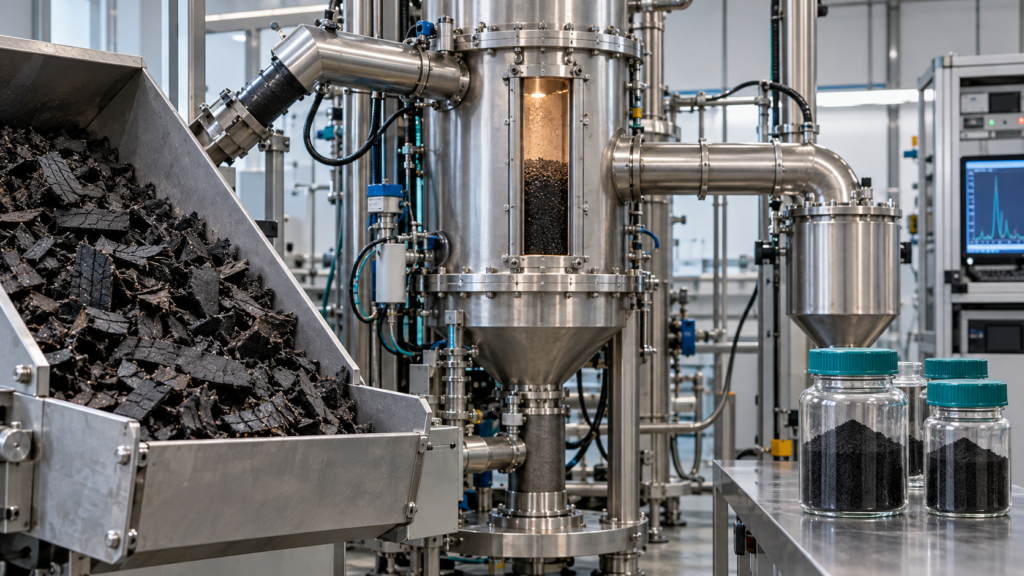
A new study has examined flash pyrolysis as a route for recovering pyrolytic carbon black from end-of-life tyres. Using a bubbling fluidized-bed reactor, the researchers tested the rapid processing of tyre granulate and reported recovery of more than 85% of the pyrolytic carbon black from coarse granulates.
According to the paper’s highlights, the process removed more than 95 wt% of volatile impurities from the carbon product. A jet flow also reduced agglomeration of the pyrolytic carbon black and improved product recovery.
Why the results matter for product quality
Recovery percentage alone does not define recovered-carbon-black quality. Volatile matter, ash, metals, particle-size distribution, structure and dispersibility can all affect performance in rubber and other compounds. Reduced agglomeration may simplify subsequent separation and preparation steps.
From laboratory result to industrial acceptance
The findings do not automatically establish equivalence between the recovered material and every commercial carbon black grade. Process scale-up, energy demand, tyre-feedstock consistency and testing in real formulations must be evaluated separately.
Gohar Farayand editorial conclusion: The study offers encouraging data for improving recovery yield and quality, but a stable industrial product will still require close control of the process and final specifications.
Image: AI-assisted editorial illustration; it does not depict the source’s actual research equipment or facilities.
Source publication date: October 2026
Primary source: Journal of Analytical and Applied Pyrolysis